
How Videoland Sports Runs Five Sports on One AI Production Stack
How Videoland Sports covers basketball, baseball, tennis, motorsport and table tennis on a single AI production stack, with automation that works with or without a play-by-play feed, and Live Tagging for the moments that happen off the field of play.
Videoland Sports (緯來體育台) is one of Taiwan's largest sports broadcasters. In a single week its team can be cutting content for professional baseball, an international basketball tournament, Wimbledon, MotoGP and Japanese table tennis. Different rights holders, different feeds, and wildly different data availability.
That mix is the hard part. Most highlight automation quietly assumes one sport and a clean play-by-play feed. A broadcaster running a full sports channel has neither luxury.
One Platform, Five Sports
Basketball, baseball, tennis, motorsport and table tennis all run through the same Spot workspace. The William Jones Cup, CPBL, MLB and U12 baseball, Wimbledon, MotoGP and T-League table tennis are handled by the same editor, the same automation and the same publishing path.
“This weekend it’s the Jones Cup, F1, Japanese table tennis, plus two baseball games. All at the same time,” said Wade, Program Manager, Videoland Sports.
That matters more than it sounds. A sports channel's calendar changes every few weeks. If the toolchain changes with it, every new competition costs a retraining cycle and a fresh set of mistakes. Videoland's team moves between five sports without switching tools.
Automation That Doesn't Wait for a Data Feed
Where play-by-play data exists, Spot's automation rules fire on the data: every three-pointer, every home run, every set point becomes a clip without anyone opening an editor.
Where the data doesn't exist, Spot reads the broadcast itself. The pictures, the on-screen graphics and the commentary are enough to find what happened.
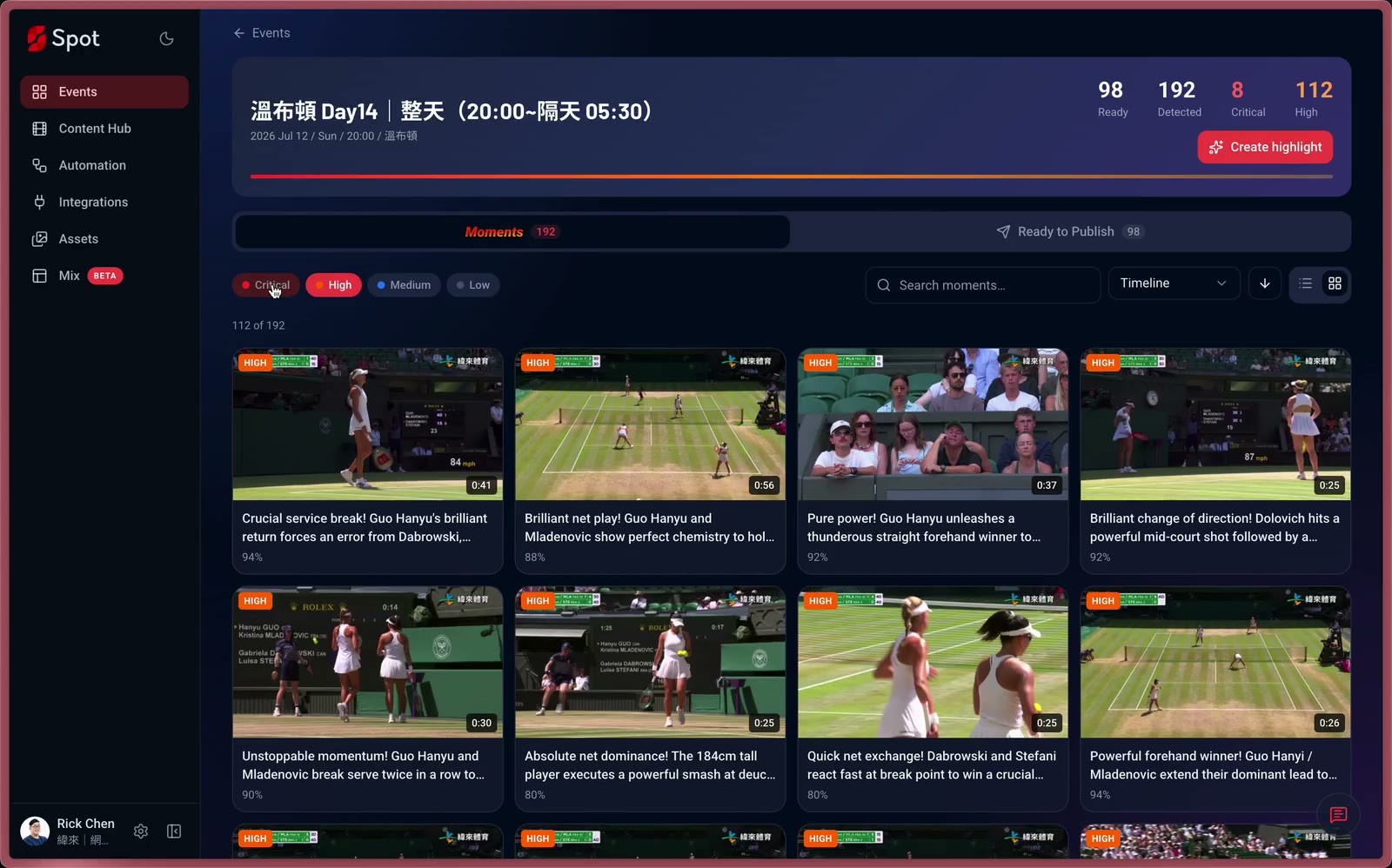
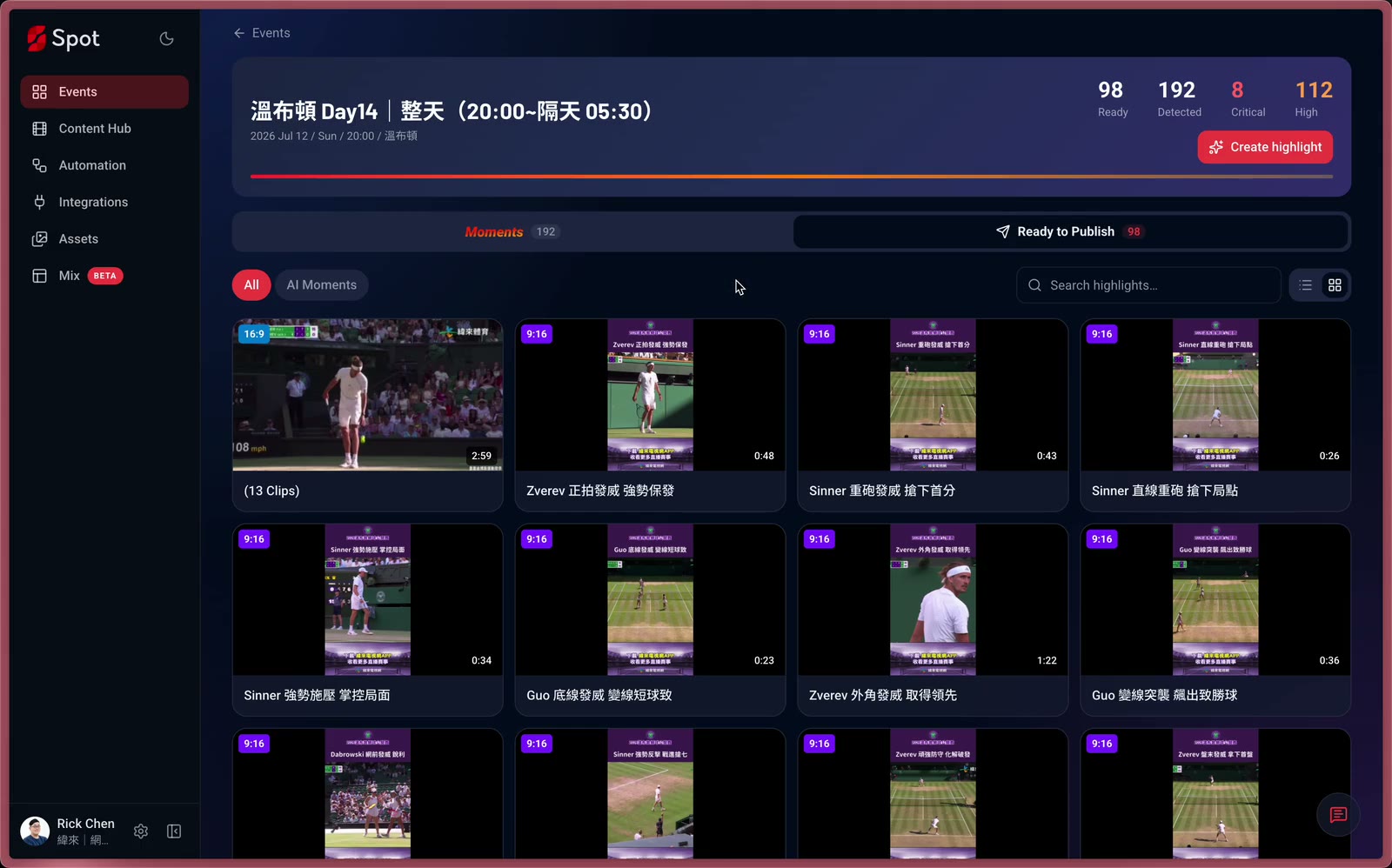
The screenshot above is a single day of Wimbledon coverage with no play-by-play data at all. Spot detected 192 moments and flagged 98 as ready to publish, each with its own headline and a confidence score so an editor can decide what to trust at a glance.
“Wimbledon was smooth. We just took the clips with the high scores and pushed them straight out,” said Wade, Program Manager, Videoland Sports.
One detail matters for anyone evaluating this: Videoland's own team built those automation rules. They were not configured by Spot on their behalf. The rules are simple enough that the people who know the sport can write them, which is the only way automation survives contact with a real production schedule.
What Happens Outside the Game
Not every moment worth publishing is a play. A fan catching a foul ball barehanded. A celebrity in the stands. A bench reaction, a coach losing it, a crowd doing something no algorithm was asked to look for. These consistently outperform routine highlights on social, and they are exactly what play-driven automation misses, because nothing in the data says they happened.
“A foul ball went into the stands and a fan caught it barehanded. That isn’t in any tag list. But those moments get traffic,” said Wade, Program Manager, Videoland Sports.
That is what Live Tagging is for. While the AI works the field of play, a producer watching the broadcast can tag anything else the instant it happens, and the clip is waiting by the time they open the editor. No scrubbing back through hours of footage to find the ten seconds they remember seeing.
The division of labour is the point. The AI takes the predictable content so the humans can spend their attention on the unpredictable content, which is usually the content worth watching.
Why It Works for a Full Sports Channel
A single-sport tool can be excellent and still be wrong for a broadcaster. What a sports channel needs is one workflow that survives the calendar: automation that doesn't collapse when a competition has no data partner, and a manual path for everything the automation was never going to catch.
If you run multiple sports across multiple rights deals, book a demo and we'll walk through your own calendar.
Frequently Asked Questions
Does Spot need a play-by-play data feed to work?
Which sports does Videoland Sports cover with Spot?
What is Live Tagging and how is it different from AI detection?
Who builds the automation rules?
Related Stories

Ready to transform your content workflow?
See how Spot can automate your live media production and multiply your content output.
Request Demo